
Nextage and Kansas State University Partner to Forge a New Era in Space Exploration at SmallSat’s 40th Anniversary
Nextage supports the next generation of engineers implementing next-gen technology.
By: Brooke Owen
October 5, 2026
Salt Lake City, UT–The Small Satellite Conference (SmallSat) has long served as a launchpad for ideas that redefine human potential. Celebrating its landmark 40th anniversary, this year’s gathering in Salt Lake City honored four decades of spaceflight innovation while setting the stage for the next generation of discovery.
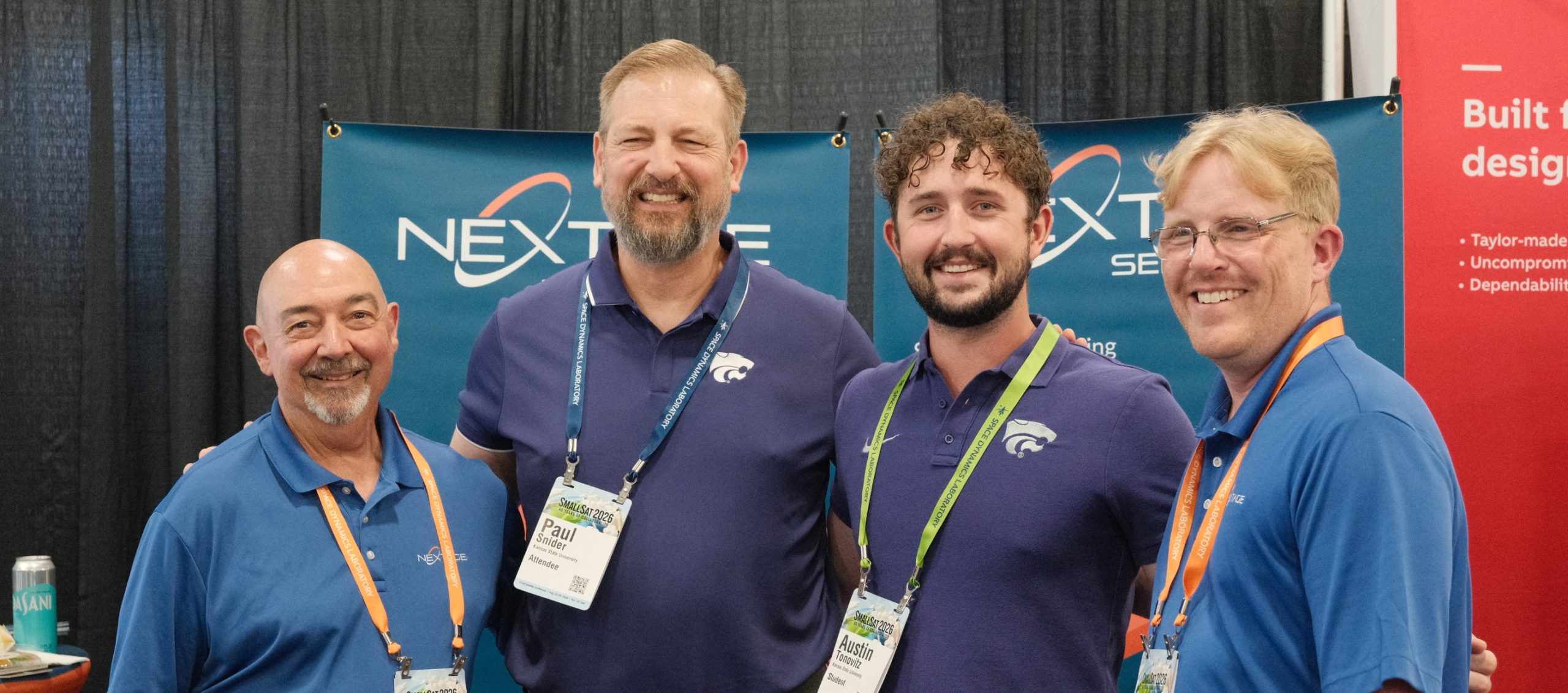
Against this historic backdrop, the atmosphere on the conference floor moved beyond routine industry updates to deliver an unforgettable milestone: Nextage and Kansas State University (K-State) signed a groundbreaking partnership agreement.
About the Partnership
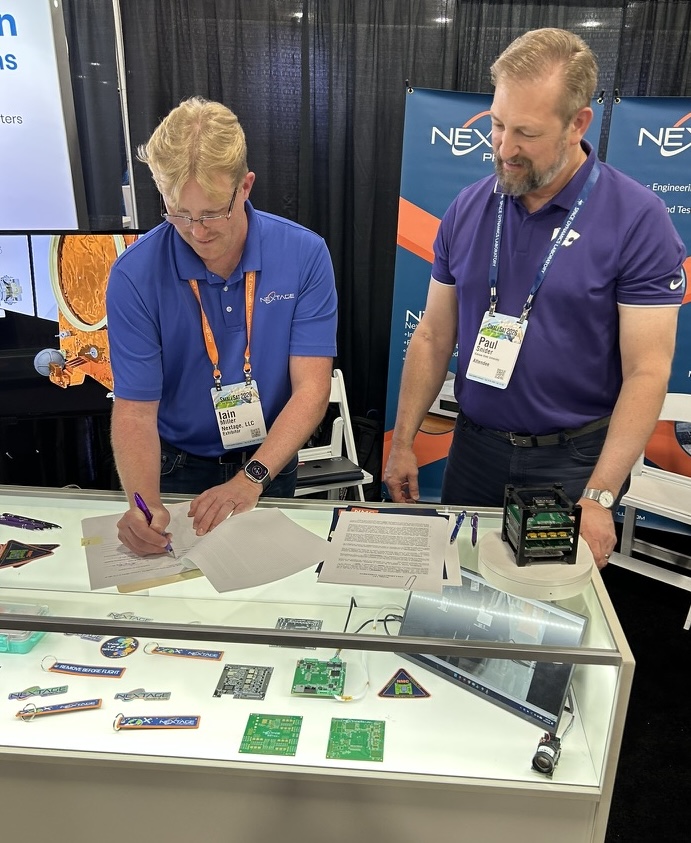
Under this collaboration, K-State will integrate the innovative Nextage Modular Computer, or NMC, into its upcoming NuKAT CubeSat mission that is tentatively set to launch in 2027. Built around the high-performance, low-power PolarFire® FPGA architecture and proprietary Triune OS, the SWaP-optimized NMC offers both serial- and parallel-processing power capable of supporting advanced computing requirements essential to innovative science satellites like those in development at K-State.
Through this partnership, K-state students will gain hands-on experience developing the code, integrating, testing, and operating the NMC on-orbit. Nextage will provide a unique hands-on learning experience for K-State students guided by our seasoned experts that prepares them to enter the workforce with a realistic understanding of the essential technical and interpersonal skills needed to thrive. Nextage is proud to support this innovative program that is developing the next generation of engineers.
Kansas State University Space
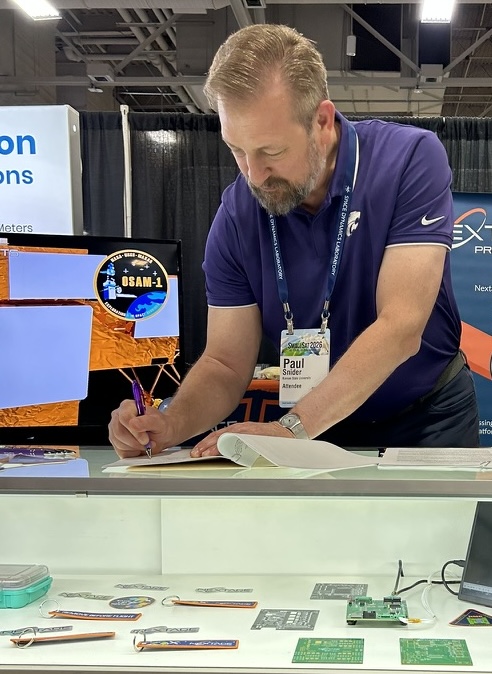
For K-State engineering students, working with the NMC isn't just about writing code or assembling hardware–it's about seeing their work soar into orbit. Led by K-State alum and Carl R. Ice College of Engineering Professor of Practice, Paul Snider, students involved in Project InCubeate developed CubeSat mission concepts their freshman year to inform designs developed by interdisciplinary senior capstone students. This pipeline engages students from the start of their degree and enables collaboration across disciplines, which provides the students with an experience that is reflective of the industry they will enter upon graduation.
Engineering students from mechanical, nuclear, electrical, industrial and chemical disciplines, as well as computer science and engineering technology departments are represented in the interdisciplinary capstone. Each discipline brings their own requirements to the NMC avionics computing platform, and the CubeSat as a whole. For many of these students, this is the first time they get to hear the perspectives of their interdisciplinary counterparts.
NuKAT CubeSat Mission Goals
Undergraduate Project Incubate students are currently developing two CubeSats over the next few years. First is the Neutron Detector: K-State Analysis Tool, or NuKAT, which serves as a pathfinder mission to test new technologies like the NMC, and lays the foundation for following missions. After the NuKAT CubeSat launches in 2027, students will shift their focus to mission operations and the development of the PHAT-Sat, or Precision Hyperspectral Agricultural Tracking Satellite. Designed in a 3U configuration, the PHAT-Sat CubeSat will collect vegetation index data for precision agriculture, drought monitoring, and resource management.
For institutions like K-State that are pushing the boundaries of miniaturized satellites, processing capability has traditionally meant choosing between cost, power draw, and radiation-tolerant reliability. The NMC solves that trade-off. Designed in a 1U CubeSat form factor, the NMC enables K-State and other missions to maximize efficiency without sacrificing performance, all while lowering the cost barrier to low-Earth orbit (LEO) science missions.
A key element of the commercialization of space-grade hardware is proven operation in space. K-State students will have the unique opportunity to validate the NMC’s operation on-orbit, providing flight heritage for the innovative avionics computer. Along with NMC, the NuKAT CubeSat will also validate the Microstructured Semiconductor Neutron Detector platform. Developed by Radiation Detection Technologies Inc., this instrument provides compact space-based neutron detection in Low Earth Orbit.
What This Partnership Means for the Future
As SmallSat marks 40 years of pioneering collaboration, this agreement represents the ultimate reflection of that legacy by building a direct bridge between next-gen aerospace technology and student ambition. The K-State and Nextage partnership illustrates what is actively taking shape in university classrooms and the space industry today:
- Building the Engineering Workforce Pipeline
K-State engineering student teams will gain hands-on experience working across disciplines with real space avionics hardware.
- Students Creating a Pathway for New Innovations
Students working on the NuKAT mission are creating the opportunity for both the NMC and the Microstructured Semiconductor Neutron Detector technology to achieve flight heritage–giving tomorrow’s aerospace innovators direct experience validating new technology.
- NMC Reaches New Heights
After successful on-orbit operation in the NuKAT CubeSat, the NMC will achieve a new TRL–technology readiness level–demonstrating its ability to equip future missions with powerful computation capability.
As Nextage and Kansas State University embark on this shared mission, the deal inked during SmallSat’s 40th anniversary stands as a powerful testament to what is possible when cutting-edge technology aligns with academic vision. Partnerships like Nextage and K-State ensure that tomorrow's workforce is equipped with the tools to solve the next era's greatest orbital challenges.